PeachBot Med — Clinical Edge Intelligence System
Real-time clinical monitoring and decision support using on-device, privacy-preserving edge intelligence.
Clinical Edge AI System
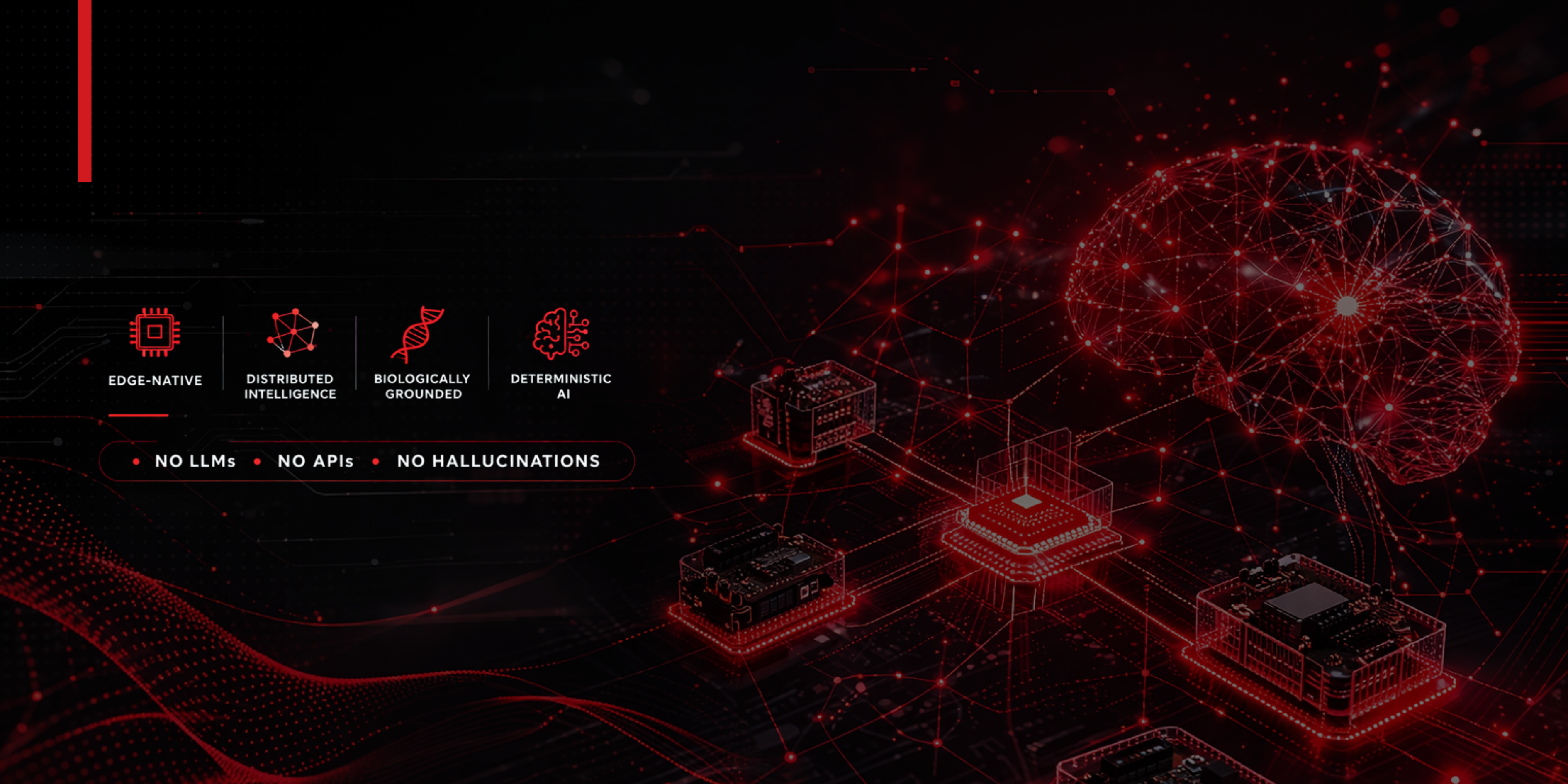
PeachBot Med & MedAI+ is a deployable clinical edge intelligence system designed for real-time monitoring, on-device processing, and structured decision support in privacy-sensitive healthcare environments.
Supports device integration, distributed deployment, and ongoing clinical validation workflows.
Hybrid Edge AI for Clinical Monitoring
PeachBot Med & MedAI+ is a clinical edge intelligence system built on the PeachBot SBC framework, enabling real-time monitoring, structured signal processing, and on-device decision support in healthcare environments.

Editorial image source: Unsplash digital health image
Overview
Extends the PeachBot SBC framework into clinical environments, enabling distributed, edge-native intelligence for real-time monitoring and structured decision support.
Processing occurs directly at the point of care, reducing latency, minimizing cloud dependency, and ensuring privacy-sensitive operation.
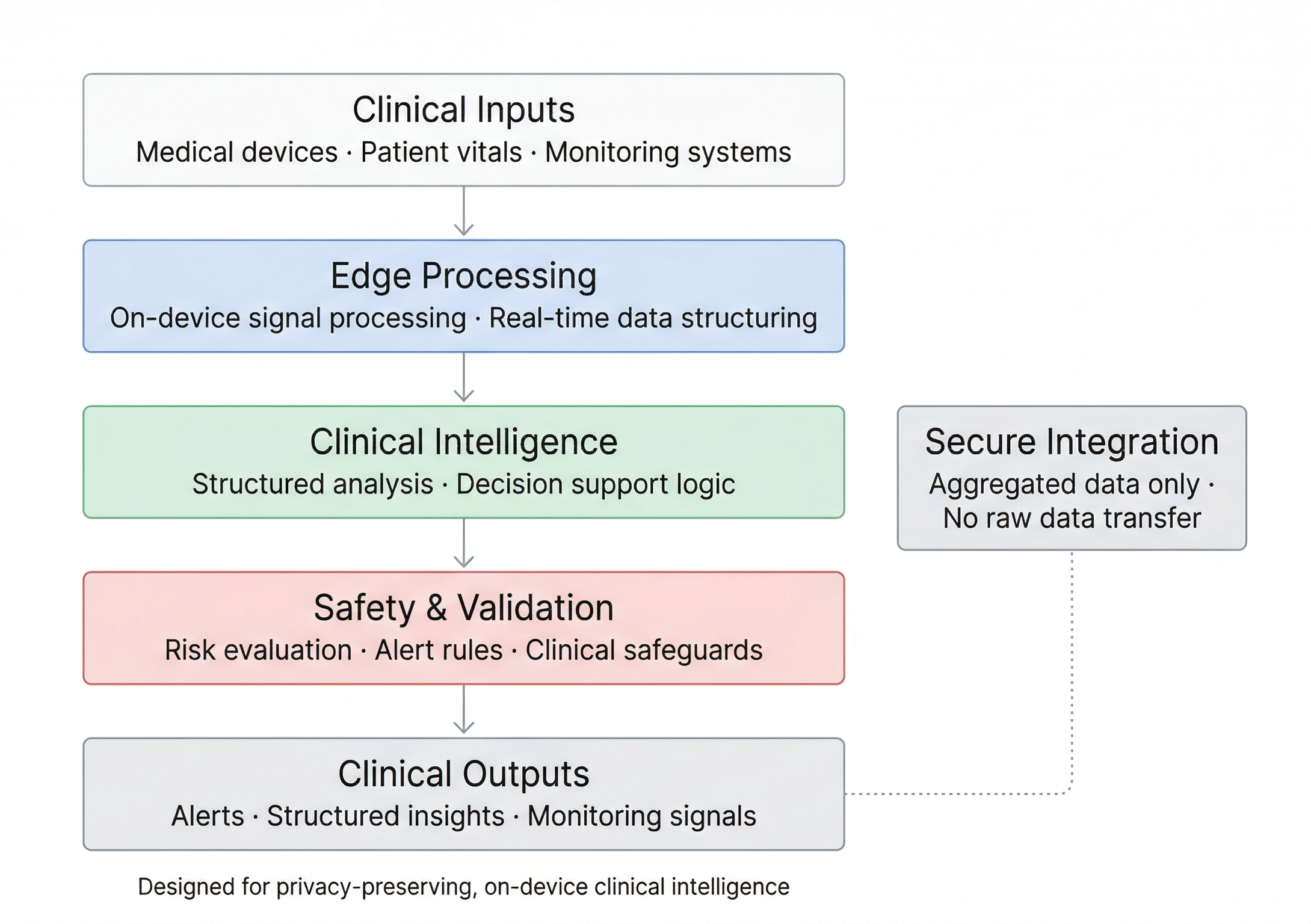
Designed for deterministic, auditable workflows with localized processing and minimal cloud dependency.
Edge Processing
On-device computation, signal ingestion
Signal Interpretation
Structured transformation of clinical signals
Decision Support
Deterministic outputs for clinical workflows
System Foundation
Built on State-Based Computation (SBC) and FILA (Federated Intelligence & Learning Architecture), enabling structured and auditable decision pipelines across distributed edge systems.
Core Capabilities
- Real-time monitoring of clinical signals
- On-device processing for privacy and latency control
- Medical device integration (ECG, sensors, monitors)
- Structured signal interpretation
- Operation in distributed environments
Clinical Context
Designed for hospitals, remote clinics, and distributed care systems, enabling continuous observation and structured interpretation of patient data.
Architecture Approach
A layered edge intelligence pipeline transforms raw signals into structured states. Computation occurs locally, while coordination happens via federated aggregation — without direct data centralization.
Research Foundations
- Edge-based Graph Neural Networks (Edge-GNN)
- Constraint-aware distributed modeling
- Biological signal computation frameworks
Research currently under journal peer review.
System Behavior
- Deterministic state transitions
- Localized learning and adaptation
- Distributed intelligence across nodes
Intended Use
Designed for clinical workflows and monitoring. Not a diagnostic system.